
Lead generation has changed dramatically over the last few years. In 2026, manually hunting for prospects, copying emails, and updating spreadsheets is no longer sustainable. Businesses that grow consistently today rely on lead generation tools that combine automation, data accuracy, and personalization.
What makes the biggest difference now is AI lead generation. Instead of guessing who might convert, AI-powered systems analyze behavior, intent, and engagement signals to help sales and marketing teams focus on the right prospects at the right time.
Below are some of the best lead generation tools in 2026, each serving a specific use case—from outbound prospecting to community-driven lead nurturing.
What Modern Lead Generation Really Looks Like
Traditional lead generation relied heavily on manual prospecting—searching LinkedIn, scraping emails, sending generic outreach, and hoping for replies. It was slow, inconsistent, and difficult to scale.
Modern lead generation tools flip that model.
Instead of starting with people, they start with signals—behavior, intent, engagement, and fit. These tools analyze data across websites, ads, email campaigns, and social channels to determine who is most likely to convert.
This shift is why AI lead generation is now central to growth-focused teams. AI doesn’t replace human sales effort—it removes friction from everything leading up to the conversation.
How AI Changes Lead Generation Workflows
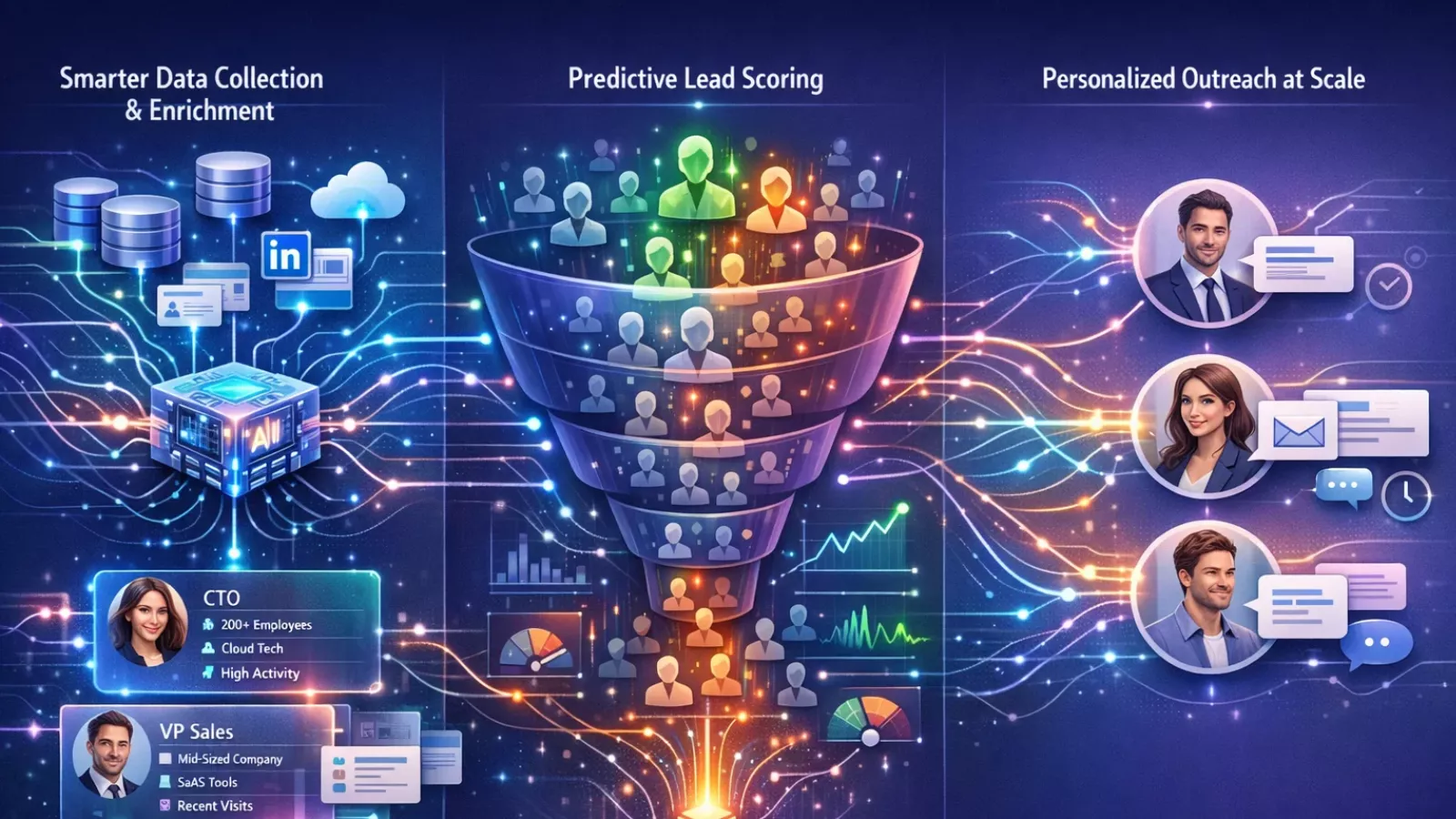
At its core, AI lead generation tools automate three major areas that once consumed most of a sales team’s time.
Smarter Data Collection and Enrichment
AI systems continuously gather firmographic, demographic, and behavioral data from multiple sources. Instead of relying on outdated databases, these tools refresh lead profiles automatically, adding details like company size, job role, tech stack, and recent activity.
This means reps no longer need to research every prospect manually before reaching out.
Predictive Lead Scoring
Not every lead deserves equal attention. AI analyzes historical data to identify patterns that signal buying intent. Engagement history, content interactions, visit frequency, and timing all factor into scoring.
This allows teams to prioritize leads that are actually ready for a conversation, rather than chasing volume.
Personalized Outreach at Scale
One of the biggest advantages of AI tools for lead generation is their ability to personalize messaging without writing every email from scratch. AI can adapt subject lines, openers, and follow-ups based on industry, behavior, or stage in the funnel.
This balance between automation and relevance is what improves response rates without overwhelming prospects.
Top AI Lead Generation Tools
1. Saleshandy – Best for Small Teams and Startups
Saleshandy is a strong choice for startups and lean sales teams that need reliable outbound results without complexity.
It focuses heavily on email-based outreach while using AI to automate follow-ups and organize replies. One of its most practical features is AI-powered reply categorization, which sorts responses into meaningful buckets like interested, booked, or not relevant. This prevents warm leads from getting lost.
Saleshandy works well for businesses that want a simple but structured approach to outbound lead generation without investing in large enterprise tools.
Best for: Startups, solopreneurs, early-stage B2B teams
Use case: Cold email outreach, follow-ups, basic automation
2. Persana – Best for B2B Prospecting at Scale
When lead volume and data depth matter, Persana stands out among AI tools for lead generation.
It combines CRM data, public web data, and intent signals to score leads based on conversion likelihood. Instead of working with static lists, teams get dynamically enriched prospects that reflect real-time changes like job switches or company growth.
Persana is especially effective for sales teams and agencies managing large pipelines who need accuracy more than raw volume.
Best for: Agencies, mid-to-large B2B sales teams
Use case: Lead enrichment, intent-based prospecting, scalable outbound
3. Klenty – Best for Multichannel Outreach
Klenty is designed for teams that don’t rely on just one channel. It brings email, calls, LinkedIn outreach, and follow-ups into one workflow.
What makes Klenty effective is its AI-powered cadence creation. Sales reps can generate entire outreach sequences—including emails and call scripts—in minutes. The platform also analyzes message performance and conversations to help teams improve response rates over time.
If your lead generation involves multiple touchpoints, Klenty helps keep everything consistent and measurable.
Best for: Sales teams running multi-channel campaigns
Use case: Email + LinkedIn + calling workflows
4. Copilot AI – Best For LinkedIn Lead Generation
LinkedIn remains one of the strongest B2B channels, and Copilot AI is built specifically for that ecosystem.
It uses AI to analyze LinkedIn profiles, engagement patterns, and past interactions to identify prospects most likely to respond. Instead of sending connection requests blindly, teams can prioritize leads showing intent or interest.
Copilot AI is especially useful for founders and sales reps who rely heavily on LinkedIn for relationship-driven lead generation.
Best for: B2B founders, consultants, LinkedIn-first teams
Use case: LinkedIn prospecting and message automation
5. Seamless.AI – Best Free Lead Generation Tool
For teams just getting started, Seamless.AI is one of the most practical free lead generation tools available.
Its free plan provides limited but usable access to verified emails and phone numbers. The platform continuously validates contact data using AI, reducing bounce rates and outdated information.
While free plans come with restrictions, Seamless.AI works well as an entry point for businesses testing outbound workflows before upgrading to paid solutions.
Best for: Small teams, early-stage businesses
Use case: Contact discovery, basic list building
6. Factors.ai – Best for Analytics and Buyer Intent
Factors.ai focuses less on outreach and more on understanding who is actually interested.
It tracks buyer intent across websites, ads, and third-party data sources, then uses AI-based scoring to highlight sales-ready accounts. This makes it especially valuable for marketing teams that want better alignment with sales.
Instead of guessing which campaigns work, Factors.ai shows how engagement turns into pipeline activity.
Best for: Data-driven marketing teams
Use case: Buyer intent tracking, account-based marketing
7. Drift – Best for Website Lead Engagement
Drift is a leader in conversational AI for inbound lead generation.
Its AI chatbots engage visitors in real time, qualify them based on predefined rules, and route high-intent leads directly to sales teams. This is particularly useful for businesses with high website traffic but low form-fill conversions.
Drift ensures that interested prospects don’t leave your site without a conversation.
Best for: SaaS and service-based businesses
Use case: Website chat, inbound lead qualification
Final Thoughts
In 2026, successful teams don’t rely on guesswork. They rely on lead generation tools that remove manual effort and improve decision-making.
Whether you’re exploring AI lead generation tools, testing free lead generation tools, or building a long-term system with platforms like SaaStrac, the goal is the same—spend more time closing deals and less time chasing leads.
AI isn’t replacing sales teams. It’s helping them focus on what actually matters.
FAQs About Lead Generation Tools.
Are AI lead generation tools safe to use with customer data?
Most reputable AI lead generation tools follow strict data protection standards such as GDPR and CCPA. However, safety depends on how the tool sources, stores, and processes data. Before using any platform, businesses should review its privacy policy, data handling practices, and compliance certifications to ensure customer information is protected.
Can lead generation tools work without a CRM?
Yes, many lead generation tools can function independently, especially for prospect discovery or outreach. However, using them without a CRM limits visibility and long-term tracking. Integrating a CRM allows teams to manage relationships, track deal stages, and measure ROI more effectively.
How long does it take to see results from AI lead generation?
Results vary based on industry, audience, and setup quality. Some teams see improvements in response rates within weeks, while others require several months to refine targeting, scoring, and messaging. AI improves outcomes over time as it learns from engagement data.
Do AI lead generation tools replace sales teams?
No. AI tools support sales teams by automating repetitive tasks like research, scoring, and follow-ups. Human involvement is still essential for building trust, handling objections, and closing deals. AI helps sales teams focus on conversations, not administration.
Are free lead generation tools accurate enough for B2B sales?
Free lead generation tools can be useful for testing workflows or early-stage outreach, but their data accuracy and depth are often limited. For consistent B2B sales results, businesses typically need paid tools that offer real-time enrichment, intent data, and advanced filtering.